Grant for age-friendly home upgrades

You can get a grant from the Norwegian State Housing Bank to make your home more age-friendly. The aim is to help you stay in your own home for longer, even if your health or needs change. A grant is money you receive that you do not have to pay back.

You can apply for a grant if

How much can you receive?

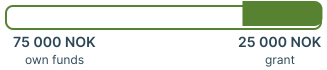
The grant can cover up to 25 per cent of the cost of the project. The upgrades must cost at least 40,000 NOK.

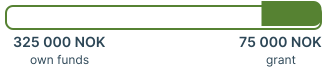
There is no upper limit to the total cost of the project, but the maximum grant is 75,000 NOK. You can only receive the grant once for each home.

Please note that you must initially be able to finance the work yourself. You can request payment of the grant only after the work has been completed and paid for.

You cannot receive a grant for a project that has already started or been completed.

What can you use the grant for?

You can receive a grant for measures that make your home easier and safer to live in as you get older. The improvements must be permanent.

You cannot receive a grant for general renovation or modernisation, and the project must not have started when you apply.

You must choose improvements from at least one of the following categories:

Click the headings to learn more about the improvements.

The aim is to remove obstacles such as changes in level, so that you have safe, step-free access to your front door.

To achieve this, you may need to

  • remove steps and other trip hazards
  • provide good lighting
  • create a spacious, level entrance area
  • level uneven ground

Good lighting makes it easier to see, while handrails can provide additional support where needed.

A clearly defined path makes it easier to find your way. For example, you can use a different colour or material for the path than for the surrounding areas.

It may be a good idea to plan these improvements at the same time as other work, such as drainage or other improvements around your home.

The aim is to have the most important rooms on one level, at the same level as the entrance to your home. This allows you to move around your home without using stairs.

Essential rooms include an entrance area, living room, kitchen, at least one bedroom, and a bathroom with a toilet. It is also beneficial to have storage space and access to an outdoor area, such as a terrace, balcony or deck.

If your home does not have all the essential rooms on one level, you can achieve this by

  • remodelling the existing space
  • extending your home

Having all essential rooms on one level is often a more permanent and practical solution than, for example, installing a stairlift or lifting platform.
The aim is to make it easier to move within and between rooms, improving accessibility and making everyday life easier.

An important measure is to provide clear and accessible routes between rooms. For example, you can

  • level out differences in floor height between rooms
  • remove door thresholds
  • widen doorways
  • move doors
  • move non-load-bearing walls to create more space in areas where space is limited

These improvements make it easier to move around, including when using a walking frame or wheelchair.

It may be a good idea to plan these improvements at the same time as other renovation or remodelling work, so that you can create a more integrated solution.

The aim is to make your bathroom easier and safer to use, helping you to remain as independent as possible in your daily life.

An important measure is to provide sufficient space and practical solutions in the bathroom. For example, you can

  • create a spacious, step-free shower area
  • provide sufficient space around the toilet and washbasin
  • replace a bathtub with a shower
  • provide step-free access and a wide doorway
  • provide good lighting

If you are renovating your bathroom, it may also be a good idea to reinforce the walls. This makes it easier to install equipment such as grab rails, a shower seat or arm supports at a later date.

It is beneficial to have the bathroom and toilet in the same room, with enough space for a washing machine.

It may be a good idea to plan these improvements as part of a bathroom renovation or refurbishment, so that the overall solution is suited to your future needs.

The aim is to make your home and outdoor areas safer, so that you can move around safely in and around your home.

An important measure is to provide good lighting and reduce the risk of falls. For example, you can

  • provide good lighting in all rooms
  • install outdoor lighting along paths and by the entrance
  • provide lighting from the parking area to the entrance
  • install night lights at floor level or along routes through your home

It is also important to ensure good fire safety in your home. For example, you can make sure that there are suitable escape routes.

For some people, it may be appropriate to adapt rooms or windows to make it easier to get out of the home in an emergency.

It may be a good idea to plan these improvements at the same time as other maintenance or upgrades, so that you can create an integrated solution suited to your needs.

You can receive a grant for a project for which you also receive support from Nav, but you cannot receive a grant from the Housing Bank for the same parts of the project that are funded by Nav.

When you apply for a grant from the Housing Bank, you must therefore provide documentation showing what Nav has approved and what financial support you have been granted.

Read more about adapting your home on the Nav website.

Apply for a grant digitally
Apply for a grant on paper (norwegian)

How to apply

Step 1: Get a quote from a contractor

Before you apply, you must decide which improvements you want to make and obtain a quote or cost estimate from a contractor. You cannot carry out the work yourself.

The quote or estimate must specify the improvements for which you are applying for a grant. Make sure that the contractor works for a legally established and registered company.

Read more about what the quote must include.

Step 2: Submit your application

Log in and apply using the Housing Bank's digital application service.

If you are unable to apply digitally, or if you are a guardian or are applying on someone else's behalf with a power of attorney, you must use the application form at the bottom of this page.

Remember to include the quote with your application. Depending on your circumstances, you may need to provide additional documentation. The application will tell you which documents you need to provide.

Application deadline: 30 October 2026

Step 3: Receive a decision on your application

The Housing Bank will assess your application and decide whether to award you a grant.

If you are awarded a grant, you will normally have around two years to complete the work. The exact deadline will be stated in the grant approval letter you receive.

Step 4: Carry out the work

Once your grant has been approved, you can start the work. You must comply with the terms and conditions set out in your grant approval letter in order to receive payment of the grant once the work has been completed.

Step 5: Receive payment of the grant

Once the work on your home has been completed and paid for, you must request payment of the grant from the Housing Bank.

You can do this either by logging in to your digital application or by using the form at the bottom of this page. You must provide documentation showing that the work has been completed and paid for.

The deadline for requesting payment of the grant is the same as the deadline you have been given for completing the work.

hus med penger. illustrasjon

Forms for applications, payments, power of attorney and consent

Here you will find the forms you may need when applying for a grant.

Grant application

If you are unable to apply digitally, you can use this form:

Apply for a grant (PDF in norwegian)

Power of attorney

If someone else is applying on your behalf, you must give that person power of attorney.

Power of attorney to apply for a grant (PDF in Norwegian)

Landlord’s consent

If you rent your home, your landlord must consent to the planned upgrades.

Landlord’s consent to home upgrades (PDF in Norwegian)

Questions and answers

A grant is money you receive. It is not a loan and does not have to be repaid.

You can apply if at least one person in your household is aged 62 or over.

You can own or rent the home, but it must be your permanent residence. If you rent your home, you must have your landlord’s consent.

Landlord’s consent form to home upgrades (PDF)

No. The project must not have started when you apply for the grant.

Once your grant has been approved, you can start the work. You will normally have around two years to complete it.

Yes. Before you submit your application, you must obtain an itemised quote or cost estimate from a contractor.

Read more about what the quote must include

No. The work must be carried out by a contractor from a legally established and registered company.

The grant can cover up to 25 per cent of the cost. The improvements for which you are applying for a grant must cost at least 40,000 NOK in total.

The maximum grant is 75,000 NOK. You will receive the maximum grant if the total cost of the eligible improvements is 300,000 NOK or more. You can spend more than this on the upgrades, but the maximum grant will still be 75,000 NOK.

Please note that the grant is paid only after the work has been completed and paid for. You must therefore be able to finance the work yourself until you receive payment of the grant from the Housing Bank.

Yes. There is no upper limit on how much you can spend on upgrading your home, but the maximum grant is 75,000 NOK.

The grant is paid after the work has been completed and paid for. You must therefore be able to finance the work yourself until you receive payment of the grant from the Housing Bank.

If you are unable to pay the full cost upfront, you can contact your municipality to ask whether they can help you find a solution.

You can receive a grant for permanent improvements that make your home more suitable for you to live in over time. These may include

  • creating step-free access
  • adapting your bathroom
  • removing thresholds and differences in floor level
  • improving lighting
  • Installing grab rails or handrails
  • other improvements that make your home safer and easier to use in everyday life

You may also be able to receive a grant for physical or digital solutions that make it easier to find your way around your home.

The eligible improvements must cost at least 40,000 NOK in total.

No. The grant does not cover general renovation or modernisation.

Yes, but you must have your landlord’s consent. Use this form to obtain your landlord’s consent and include it with your application.

Landlord’s consent form to home upgrades (PDF in Norwegian)

Provided that the improvements you are applying for meet the criteria for the grant and will help you continue living at home for longer, applications are prioritised based on income. Applicants with the lowest incomes are given priority.

The application deadline is 30 October 2026. You will receive a decision no later than six weeks after the application deadline.

If you are awarded a grant, you will normally have around two years to complete the work.

Yes. You can find the paper application form here.